ORIENTA 7: MAPPING THE CITY IN UNEXPECTED WAYS

By Chourouq Nasri
Oujda, Morocco
October 10 – November 30, 2019
The way art can transform the city is the theme that knits together the key moments of Orienta 7, an art event organized in Oujda, Morocco from October 10 to November 30, 2019. Orienta’s curator, Azzeddine Abdelouahabi is an artist and art critic who lives between Amiens (France) and Oujda (Morocco). To show art’s potential for social and spatial subversion, he invited local and international artists to remap the city in a new way. Their artworks coalesce into narratives that unlock the parallel between the intimate and the global.
Beyond the Arab Spring: Street Art in Morocco, Political Protest or Tool for the State?

By Chourouq Nasri
Oujda, Morocco
When revolutionary fervour swept across North Africa and the Middle East in the spring of 2011, city walls in the region began to carry messages of resistance and images of fallen frontline activists, as artists sought speak out against political repression in their countries.
Noting the creative response to the uprisings in their neighbouring countries, instead of scrubbing away spray-painted tags, the Moroccan authorities chose to encourage murals and other colourful street art, offering a legal venue for artistic expression.
Poetry As Resistance: An Ecocritical Reading Of Sameh Derouich's Haiku
Sameh Derouich is a pioneer of Moroccan haiku who published his first haiku collections in 2015, in post Arab Spring Morocco. 1 100 Haiku, I Am Many and Illuminating Beetles are the titles of his three haiku collections. Derouich who is a prolific writer has also published many collections in other poetic forms. 2 While he has begun his literary career as a free verse poet, Derouich moved a few years ago to haiku poetry, writing the innovative poems he is best known for. More than a type of poetry, his haiku is an ecological project of an extraordinary range. By writing complex and elusive, yet concise visual-verbal haiku, he engages singularly with being on earth. This article aims at developing an ecopoetic approach to Sameh Derouich’s haiku poetry. I propose to read the poet’s recent poetry collections as a response to the contemporary environmental crisis as well as a way of resisting the ordinary and the obvious. Derouich broke away from familiar ways of verse writing in Morocco and adopted a poetic form which is regarded by many Moroccan poets as an inferior form of poetry writing. In spite of its pronounced linguistic economy, haiku poetry helps him challenge the confines of the city and express an acute awareness of the limitations of the urban space he lives in. On the other hand, the haiku form reflects the city experience itself; its constrained length resembles the closed spaces of the city.
The international festival of theatre organized in Oujda by Commedrama, a joyful journey of discovery

The ninth edition of the international festival organized in Oujda from May 12 through May 16th 2016 was a memorable event for the oujdi public. Commedrama, a theater company based in Oujda succeeded in transforming Théâtre Mohamed 6, a big building constructed a year ago, into an international public arena in which the audiences were offered the chance to see new and unfamiliar works. Every night, people came to see plays from different countries Algeria, Switzerland, France, Mexico, Spain and Morocco. The program of the festival was designed by Mohamed Benjeddi, the artistic director of Commedrama and Hjriya Amara, the president of the company. It gave oujdi audiences the gift of an international, multidisciplinary theatre in which performers and spectators were united in a joint adventure and exploration of dramatic experience.
Le docteur Miracle, a Comic Operetta based on Georges Bizet’s text
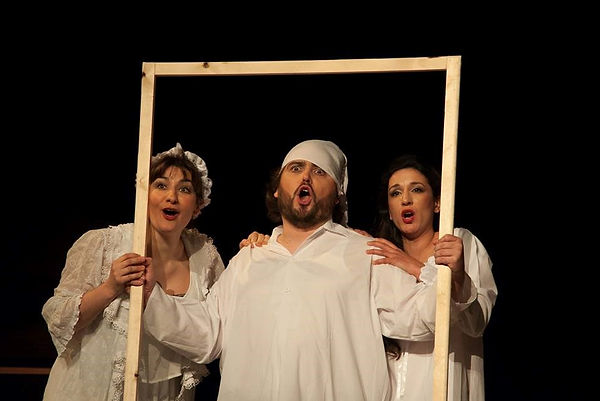
Le docteur Miracle, a French comic opera in one act written by the French composer Georges Bizet in the 19th century and produced by the French Company “Opera Ex Nihilo” was the first performance to take place in the festival. This was probably the first time an opera was performed in Oujda. The musical play is about trying to get Silvio and Laurette together and married. Le docteur miracle is in fact an officer, Silvio who is in love with Laurette, the mayor’s daughter and who made many attempts in order to be united with her. Laurette’s father does not like the military and is against his daughter’s marriage with Silvio. In order to be close to Laurette, the officer disguises himself as a servant who has to prepare the meals and serve the family. But the mayor finds out his true identity and fires him. Silvio then disguises himself as Docteur Miracle and offers to cure the mayor who thinks that he is empoisoned in return for Laurette’s hand in marriage.
In this opera, our visual and auditory senses are delighted by brilliant singing and brilliant acting. The combination of romance, humor, and astounding music turns the stage into an emotional and mobile space constantly changed by the performers. The “Omelette quartet” is one of the most hilarious and ravishing moments of the opera. When Pasquin (Silvio) serves the omelette, the family sings its praises and offers a cocktail of humorous music. But when the mayor and his wife and Laurette taste it, they all start to choke because it is disgusting.
In Rahela, theatre is a seeing, hearing and smelling place!

Rahela is an Algerian a Cooperative theatre El Bahdja production. It is written by Meriem Alleg and directed by Tounes Ait Ali. Tounes Ait Ali is also the actress who plays the role of a single mother who mixes reality and illusion and suffers from hallucinations. The story is filled with clichés: a girl is forced to marry at a young age with an old man; she is rejected by her family because she asks for divorce and obtains it; she falls in love with a man she encounters at court but he turns to be a rapist and the one person he rapes is his own stepdaughter!
Still, Rahela is not entirely void of merit. The physical power and the agility of Algerian actress, Tounes Ait Ali compensates for the poor quality of the plot. The visual and scenographic media used in the play transform an ordinary text into an amazing show. Every inch of the theatre space is exploited to the maximum. The stage is divided into two spaces, a sensory and visual space and a verbal space. In the first part of the stage, the everyday patterns of folk art serve both a functional and decorative purpose. It is occupied by a musician who does not have a role in the story but whose music contributes to give shape to the dramatic experience. The second section of the stage is decorated in dark colors with what seems to be an inner room concealed behind curtains and a child’s dress which is floating in the air. This space is reserved for the protagonist and narrator of the play. By dividing the stage, the dynamic of the space is altered and the spectators are allowed to see two actions at the same time while becoming aware of the difference in status between people on either side of the stage. The play is a series of overlapping images that melt seamlessly one into another, conveying atmosphere and mood as well as location. The scene changes are as much verbal, as visual.
In Rahela, theatre is a seeing, hearing and smelling place!
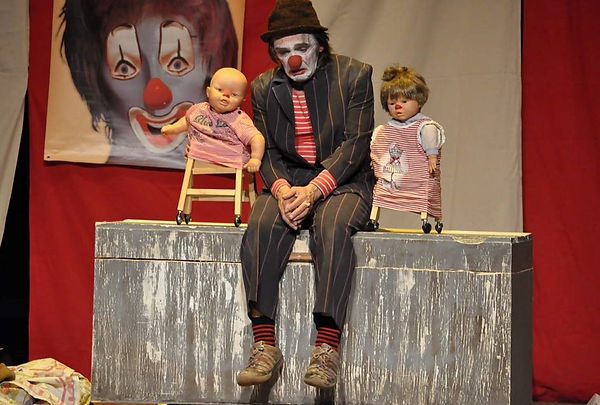
Quimera is a Company Gargallada Teatro production written by Gabriel Prada Rodriguez and directed by Paco Juan Prada Cobo. The play tells the story of a sad clown who invents happiness by using the props and accessories he finds in his case. A solitary actor, an empty space, a grey box and a case convey the whole world of the clown: past, present, reality and fantasy. The clown fills the stage with his energy and color, conveying a belief to the audience that three dolls could stand for his wife and his two children. His humorous external environment is in direct contrast to his internal, painful world. To tell the sad story of a lonely man, the author chose to create an actor in a non verbal space, exploring the interaction of the performer, the music, the space and the public. The combination of music, lighting and brilliant acting tells an entire story that words could not convey. The plain grey box becomes a truly expressive space that tells an unspoken story of fear and isolation. The confrontation between spectators and the non-verbal image directly challenges our perception of where we are and what we understand by theatre.
Moi, Ota, la rivière d'Hiroshima, a wonderful play filled with poignant, lyrical imagery!

Moi, Ota, la rivière d'Hiroshima is a play produced by the Swiss company, Compagnie TA58. The text is written by Jean-Paul Alègre and directed by Cédric Laubscher. Ota, the river of Hiroshima is a focal point of the city and the play. Swiss actress Natacha Astuto who is dressed in a marvelous white costume tells the story of Hiroshima. Different stories are intertwined: the USA presidents and his scientific consultant who prepare the atomic bomb; the inhabitants of Hiroshima who know nothing of their imminent tragic fate; the river Ota who continues to flow through the villages and the towns and whose lyrical text says how peaceful and happy people’s lives are.
Three grey, plain benches are the only furniture used in this play. Still, space becomes a living personality with a past, a present and a future. Space is shaped and altered by the actors as the play evolves. All the different parts of the stage live at different times of the performance through the use of light or the placing of the actors. As Ota moves swiftly between the actors and tells the poignant story of Hiroshima, in sparkling, lyrical language, Natasha’s voice becomes visual expressive space that encourages the audience to believe what they could see and to imagine what they could not. Her words make the stage live and breathe and engage the audience who can imagine cities, villages, rivers and mountains without any scene changes. Music and lighting are used to indicate simultaneous happenings in different places: Tokyo, Hiroshima and Washington. Parallel worlds are created on the stage, portraying different places, subtly interwoven at times, and yet seeming separate. Scenography is used in such a way as to enhance and reveal the text and the story behind it and provide a human face to a historical, but “abstract” event. The stage floor becomes the most important visual focus. The play experiments with different media: music, lighting, video, sounds. All are used to prepare us for the crucial moment of the play, the explosion of the atomic bomb in Hiroshima. All throughout the play, the public is touched with the expectation that a huge bomb will soon explode. When it finally explodes, the whole building is shaken! The spectators are scared! Their real time and lives are fused into the dramatic time of the play!
In Ghorba, a small team of talented actors address the theme of migration

Commedrama participated in the festival with a play entitled Ghorba. It is a comedy which tells the story of three men, who disguise themselves as women in order to work for a company in Spain which hires only women. A shabby, small house in a poor neighborhood is the most important unifying visual element and is a symbolic element at the heart of the play. The plot of the play moves from interior with one of the characters sleeping and dreaming of going to Spain to exterior with other characters who share the same dream. Actors move through the different parts of the stage fluently and naturally so that the audience’s eyes is constantly being taken from the extremities of the stage space to smaller focused moments. An unseen world offstage is indicated simply by the manner in which the actors arrive, sometimes running at speed with great urgency. The play deals with political and cultural themes such as migration and racism in a humorous way. The Cast are brilliant; it offered a funny and interactive evening to the public. The actors pull you into their world so you can relate to them. But the story is simplistic and superficial. The last scene is one of the most beautiful moments of the play. Lighting is manipulated in such a way as to offer the audience a black void in which only moving mouths and eyes are visible, seemingly suspended in space. All the characters are united in this final scene; they talk about their dreams using very few words.
Popol-Vuh, a wonderful connection between word and vision!

Popol-Vuh is a Mexican play produced by centre culturel Gibran Khalil Gibran and directed by Josué Cabrea. The play tells the story of creation according to a Maya legend. The Mexican company offered a well-prepared production, beautiful to look at and beautifully played. With the blend of color, image, music and words, space becomes charged with life and action, engaging through direct address and dialogue with the audience. The public watched a magical world of masks, painted wooden birds, wooden animals and trees and was transported to the ancient Maya world of myth and mystery. Actors’ faces are painted like masks, their mouths and eyes heavily accented and colored. Their expression comes from their gestures and physical body movements off-stage narration, music, dance, song, costumes and acting bring everything together. The combination of different scales and strong colors reflected the author’s vision of life as a mixture of reality and fantasy.
The international festival of theatre was a joyful journey of discovery through which oujdi audiences were transported from their own lives into another reality for a short time. The public was offered the opportunity to watch plays in their original language and to discover the international language of theatre.
The Liberating Force Of Art, Humor And Social Media: Women Cartoonists Of The Arab Spring
Introduction
In this chapter, I address the intersection of humor and gender2 by investigating the way cartoons are used as an empowerment strategy by Arab Spring female cartoonists. I discuss visual satire as a method women use to challenge power relations. Female cartoons provide an example of how caricature is used not only to reduce tensions, but also to introduce unpleasant opinions and to create a subversive space3. This paper draws on the phenomenological humor4 theory according to which, “the comic conjures up a separate world, different from the world of ordinary reality, operating by different rules” (Berger x). Scholars adhering to this approach5 think that humor is a ““looking glass” allowing us to look at the world and ourselves in a slightly distorted, and hence revealing, way” (Kuipers 380).
Humour des caricaturistes marocains: rire rebelle ou simple mécanisme de divertissement ?

INTERLIGNES, LE RIRE ICI ET LA, PRINTEMPS 2017 (N 8)
Dans cet article, je m’interroge sur la place de l’humour dans la presse marocaine d’aujourd’hui. Sur la base d'un corpus de dessins humoristiques parus dans quelques journaux nationaux[1], une analyse a été faite dans le but de mettre en lumière le fonctionnement de la caricature diffusée par la presse marocaine et d’en saisir le potentiel subversif. Le dessin de presse[2] est un mode d’expression dont l’existence au Maroc remonte à la fin des années 1960[3]. Cet art graphique humoristique repose sur la déformation et l’exagération des traits d’une personne ou d’une situation[4]. Les caricaturistes dont la ressource est l’actualité mettent en avant l’absurdité d’une situation ou bien dénoncent l’action d’une personnalité publique. Le dessin de presse est de ce point de vue un mode d’information qui complète le contenu rédactionnel. C’est un moyen d’expression qui informe le public et porte un regard critique sur l’actualité. La caricature a des avantages sur les autres modes de communication ; elle est brève, piquante et atteint toutes les couches de la société. A défaut de presse satirique à part entière au Maroc, la caricature se disperse dans les journaux qui veulent bien l’accueillir tels, Almasae (Le soir), Alakhbar (Les informations), L’économiste, Le soir écho, et Asahrae Almaghribiya (Le Sahara marocain).
Abdelghani Dahdouh
On affame bien les rats d’Abdelaziz Mouride : « les années de plomb » au Maroc dans un bédé - reportage

Abdelaziz Mouride, op. cit., p. 12.
Introduction
Dans On affame bien les rats, Abdelaziz Mouride1 transforme la bande dessinée en une écriture transgressive. Mouride était un membre fondateur du mouvement du 23 mars. Il est arrêté en 1974 et passe dix années en prison, sur les vingt-deux ans auxquels il est condamné. Il crée cette bande dessinée durant son incarcération mais ne réussit à la publier qu’en 2000. Mouride utilise le médium BD pour créer un reportage illustré dans lequel il raconte sa propre expérience carcérale. Tazmamart, Derb Moulay Chrif, Qalaat Magouna, des lieux presque « mythiques » que seuls les prisonniers des années de plomb2 et leurs geôliers connaissentréellement sont mis en image pour braver l’interdit d’un régime hostile à la liberté d’expression.
De Médine à Oujda, la place des femmes dans les villes arabo-musulmanes
Introduction
Près de dix ans après la réforme du code de la famille, les femmes dans la société marocaine se retrouvent dans une situation paradoxale. Elles ont leur part à jouer dans les institutions publiques ; mais, elles ne peuvent toujours pas échapper aux stéréotypes selon lesquels la place de la femme est à la maison. Les hommes et les femmes continuent de s’identifier à des territoires distincts : les hommes appartiennent au « dehors » et les femmes sont des êtres de « l’intérieur ». L’organisation sexuée de l’espace dans les villes marocaines est intiment liée à des héritages culturels très anciens ; elle montre la place de la femme dans notre société et trahit un décalage important entre ce que nous croyons être et ce que nous sommes. Dans Le processus de formation de la raison arabe, Mohamed Abed al-Jaberi dit que « l’héritage le plus important que les ancêtres nous ont légués est un système de censure tellement omniscient et efficace, où le politique et le religieux collaborent si étroitement, qu’on en est arrivé à confondre al-aql (la raison) avec cette censure même. »
Abounaddara:
The Cinema of Emergency for an Alternative
Image of Syria

This paper discusses the short films produced by Abounaddara, a group of anonymous Syrian filmmakers who approach the military conflict from a new perspective, converting documentary films into a living memory for Syria.
The media coverage of different forms of violence that have been perpetrated in Syria for years has minimal impact on viewers who are no longer affected by images of dead bodies and massive destruction. TV newsrooms only focus on “scoops,” competing in a wild race to dispatch unsettling images of violence. Victims, be they men or women, are emotionally and physically stripped to bring news-avid viewers a shortlived pleasure. Reports have made a “déjà-vu” event out of the Syrian war and have detached Syrians’ everyday lives from reality.